AI is everywhere right now. Click a button and you get clear skin, smooth tones, and a shiny finish. Looking from the outside, you might think retouching is dead. Then you open a real advertising campaign instead of a phone selfie, and the algorithm trips over itself instantly.
Here is why automation will not push human artists away from their Wacom tablets and Photoshop.
The biology of perception: why our brain spots fakes
Our brain spent millions of years learning how to read human faces. Deep inside, there is an area called the Fusiform Face Area. It works like an internal scanner, catching the slightest visual lie in a fraction of a second.
The human eye knows natural physics. Real skin does not just bounce light back. It lets light sink in and softly scatter beneath the surface. In 3D and high-end retouching, we call this subsurface scattering. It is the exact reason a face looks warm, dimensional, and alive.
AI simply does not understand volume from the inside out. It just paints flat pixels over the top. Light bounces off that skin like it hit a plastic cup. Add uncanny robotic symmetry, blurred microtexture, and fake eye catchlights. The brain immediately enters the uncanny valley and screams that you are looking at a mannequin.
Loss of microtexture and the plastic look
Algorithms run on probability. They have no concept of human anatomy, so they just blend and average out nearby pixels. High-end beauty retouching relies on the opposite: natural pores, freckles, microrelief, and subtle tonal shifts.
What does AI deliver? Pure mush. The face turns into a flat wax figure. A professional retoucher works differently, cleaning blemishes locally with Dodge and Burn while keeping the natural skin grain untouched. The goal is never to repaint the person, but to refine what is already there.
Brand guidelines, Pantone match, and color accuracy
In commercial photography, color means money. When a brand shoots a lookbook, the dress on screen must match the real fabric against the physical Pantone swatch without exceptions.
Neural networks do not care about client guidelines. They push colors toward their own algorithmic idea of pretty, shifting skin undertones and altering garments. As a retoucher, I keep strict control over every color channel. If a red coat leans slightly magenta on the website, customers will return the entire batch.
Non-destructive workflow and client revisions
Every producer knows that feedback is inevitable. The art director will always ask to tone down a highlight by 10 percent, recover shadow contrast, or tweak a lipstick shade.
AI hands you a single baked layer. If you need to fix one detail, you have to reroll the prompt from scratch and pray. Professional retouching is strictly non-destructive. Clean-up sits on its own layer, Dodge and Burn on another, color grading on adjustment layers above. I can adjust any client note in seconds without damaging the base plate.
NDA and legal risks
Uploading unreleased client raw files to an online AI generator is a fast way to get sued. Brands make us sign strict NDAs before we even touch the files. No serious company will let anyone feed an unreleased lookbook into public servers that use customer uploads for training.
On top of that, copyright laws around generative imagery remain messy in most jurisdictions. No serious brand will build a multi-million-dollar campaign on assets they cannot legally protect.
AI as an assistant, not a creator
Do I hate AI tools? Not at all. They are fantastic for routine tasks. Expanding backgrounds, building quick mockups, or generating base textures saves a lot of time.
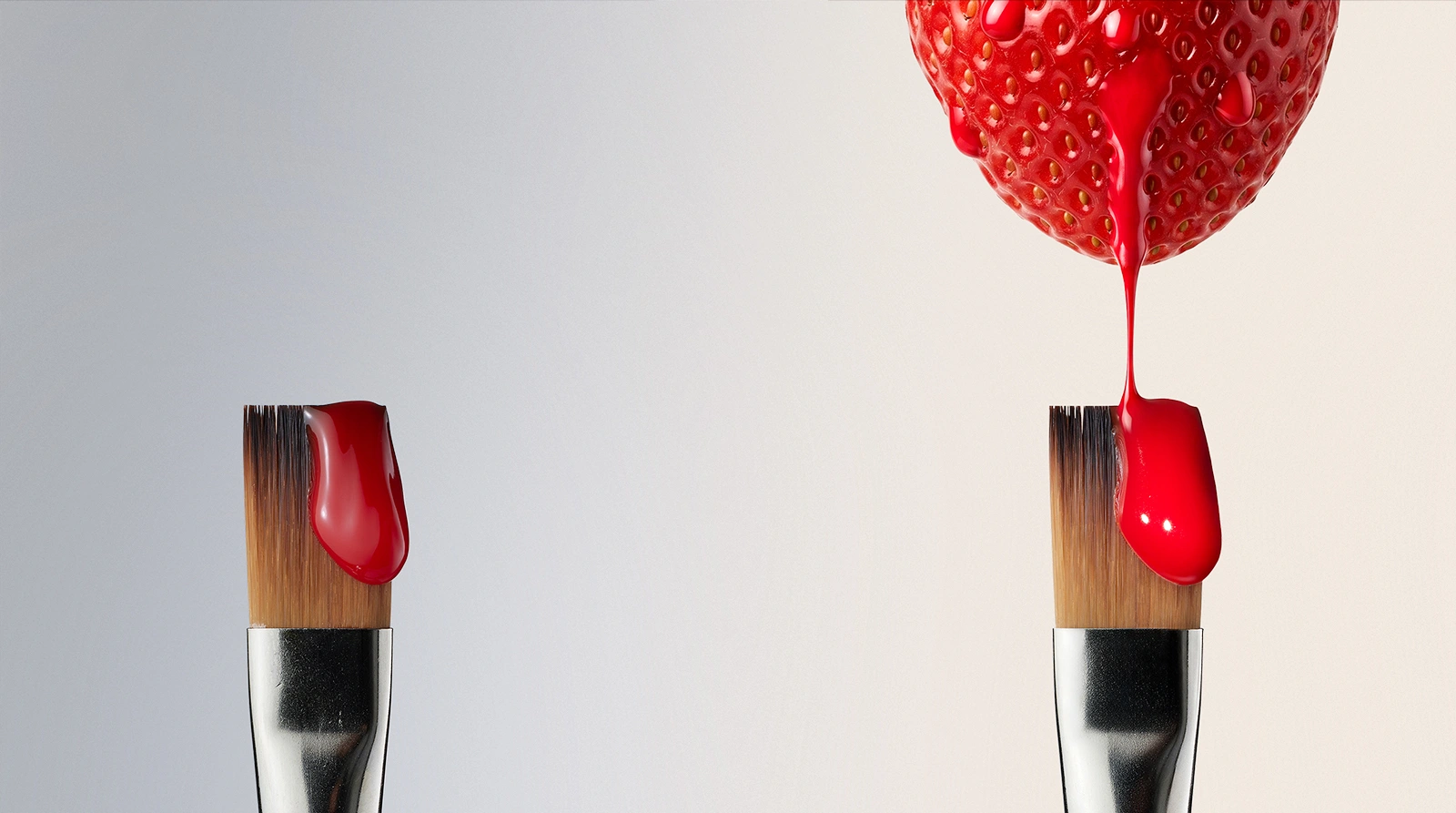
Left: RAW (photo: Ksenia Bolshakova). Right: my commercial product retouching, AI asset integration, and manual painting of the liquid flow.
Still, integrating those pieces into a clean plate, balancing the shadows, matching perspective, and correcting light falloff requires a human hand. The algorithm gives you raw puzzle pieces. The retoucher turns them into a finished piece of art.
AI handles repetitive chores. But visual taste, discipline, and final accountability belong to the retoucher. Real craft is not going anywhere.